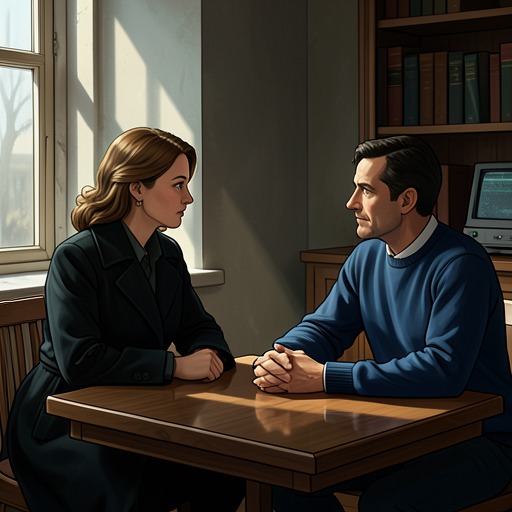
Jake and the Narrator Meet at the Campus Pub
I'm Thinking of Ending ThingsJake and The narrator Meet at the Campus Pub is the remembered first encounter that turns an unplanned trivia night into the beginning of their connection. Its significance lies in the mismatch between what each seems willing to do openly and what each wants: The narrator cannot bring herself to ask for Jake’s number, while Jake, shy in person, quietly leaves his in her purse.
Setting and Circumstances
The meeting takes place during trivia night at the Campus Pub, a venue The narrator rarely visits. She is no longer a student and feels old there; she has never eaten at the pub, and its tap beer tastes dusty to her. Trivia is not her interest, either. She and her friend are sharing a pitcher and chatting rather than concentrating on the game, a relaxed sideline position that leaves room for the conversation to begin.
The narrator suspects, without knowing for certain, that her friend chose the Campus Pub because she thought The narrator might meet a boy there. Jake and his friends are seated at the neighboring table. The narrator is not expecting to meet anyone, and the setting’s social purpose remains an inference on her part rather than something her friend says aloud. The meeting begins in proximity, not through a planned introduction.
The First Exchange
Jake’s trivia team is called Brezhnev’s Eyebrows. After he and The narrator have been talking for a couple of minutes over the loud music, she asks, “Who’s Brezhnev?” Jake explains, “He was a Soviet engineer, worked in metallics. Era of Stagnation. Had a couple of monster caterpillars for eyebrows.” The team name is meant to be funny, but its obscurity also displays specialized knowledge of the Soviet Communist Party. That combination catches The narrator’s attention in a way she finds exasperating: the joke seems designed to be both amusing and a demonstration of what its maker knows.
Jake is clean-shaven and wears thin-framed silver glasses, adjusting their right arm absentmindedly and sometimes pushing them up with an index finger at the bridge. When concentrating, he smells the back of one hand or holds it beneath his nose, a habit that continues later. The narrator remembers a plain, much-washed T-shirt, though she is unsure whether it was gray or blue, as well as jeans and frequent blinking. She reads him as shy. He smiles once, but she thinks that if she left the encounter to him, they could sit beside one another all night without speaking.
Because she can tell Jake is not going to say anything, The narrator initiates the conversation: “You guys are doing pretty well.” Jake raises his beer glass and replies, “We’re helpfully fortified.” The small exchange breaks the ice. Later, he casually tells her, “I’m a cruciverbalist.” Before going to bed, she looks up the word, laughs, and believes him. His vocabulary and obscure humor make an impression not because trivia itself interests her, but because his manner combines restraint with a confidence she senses beneath it.
A Conversation and a Mutual Invitation
Later in the evening, Jake says, “People just aren’t very funny. Not really. Funny is rare.” The narrator likes the definitiveness of his judgment about people, even though she is not sure it is true. She replies, “I don’t know if that’s true,” and notices a confidence bubbling beneath his reserved manner. Their exchange moves beyond the team’s trivia answer: Jake makes a broad claim about humor, and The narrator responds to both its certainty and the person expressing it.
As Jake and his teammates prepare to leave, The narrator considers asking for his number or giving him hers. She very much wants to, but cannot bring herself to do it. She does not want Jake to feel obliged to call; at the same time, she wants him to want to call. Rather than risk making the invitation herself, she settles on the possibility that she will see him again in the university town. Her hope is real, but in the moment she leaves their next meeting to chance.
The Note and the Encounter’s Significance
Jake has acted while saying good night: he must have slipped a note into The narrator’s purse. She finds it after getting home. It reads, “If I had your number, we could talk, and I’d tell you something funny.” His number is written at the bottom. The note answers the unspoken question neither raised directly at the pub. It also echoes their conversation about humor, offering not a grand declaration but a specific reason to continue talking.
The gesture reverses the apparent imbalance of the goodbye. The narrator had assumed she would have to wait for chance, while Jake’s concealed note reveals that he, too, wanted contact and had found a way to make it possible. Her later search for the meaning of “cruciverbalist,” and her laughter when she confirms it, extends the encounter beyond the pub: she carries his words home and follows their meaning on her own. In this recollection, their connection begins through small acts of attention—the question she asks, the detail she notices, and the number he leaves where she will find it.